메뉴 하나 고르면 식자재 발주까지…단체급식 주문 방식이 바뀐다
식자재유통 | 2026.10.16
메뉴 하나 고르면 식자재 발주까지...단체급식 주문 방식이 바뀐다
CJ프레시웨이, 메뉴주문시스템으로 단체급식 경로 식단 구성·발주 업무 효율화
식수 인원 맞춤 식자재 산출로 발주 정확도 높이고 폐기율 감소 기대
메뉴 데이터 기반 솔루션으로 단체급식 운영 표준화 지원
단체급식 현장에서 영양사는 매일 식단 구성부터 식재료 산출과 발주, 원가 관리, 조리 공정 확인까지 다양한 업무를 수행한다. 영양 균형과 메뉴 다양성을 확보하는 동시에 한정된 예산과 인력 안에서 안정적인 운영까지 책임져야 한다. 특히 식수 인원에 맞춰 필요한 식재료와 발주량을 일일이 계산하는 과정은 많은 시간과 경험을 요구한다.
급식 이용자의 기대 수준도 높아지고 있다. 구내식당에서도 외식 트렌드와 제철 식재료를 반영한 새로운 메뉴를 원하는 수요가 늘면서 영양사의 메뉴 기획 부담은 더욱 커졌다. 반면 현장에서는 운영 인력 부족과 업무 과중이 이어지고 있어 식단 구성과 발주 과정을 효율화할 수 있는 체계적인 지원이 중요해지고 있다.
CJ프레시웨이는 이러한 현장의 어려움을 해결하기 위해 메뉴와 식재료 주문을 하나로 연결한 ‘메뉴주문시스템’을 운영하고 있다. 기존에는 필요한 상품을 개별적으로 찾아 주문했다면, 메뉴주문시스템에서는 제공할 메뉴를 선택하는 것만으로 식재료 구성부터 발주까지 연계할 수 있다.
메뉴주문시스템은 단순한 주문 기능을 넘어 메뉴 기획과 조리, 발주 등 급식 운영 전반을 지원하는 솔루션이다. 현장에 축적된 메뉴 데이터와 운영 노하우를 체계화해 영양사의 반복 업무를 줄이고, 사업장별 운영 품질을 일정한 수준으로 유지하는 데 초점을 맞췄다.
식자재를 고르는 방식에서 메뉴를 중심으로 주문하는 방식으로 단체급식 발주의 기준을 바꾸고 있는 메뉴주문시스템. CJ프레시웨이 유통 사업의 성장을 위한 시스템 기획 및 개발을 총괄하는 신승윤 CJ프레시웨이 급식혁신성장사업부장을 만나 메뉴주문시스템을 개발한 배경과 현장에서 기대되는 변화, 향후 발전 방향에 대해 들어봤다.

Q. CJ프레시웨이의 메뉴주문시스템은 어떤 서비스인가?
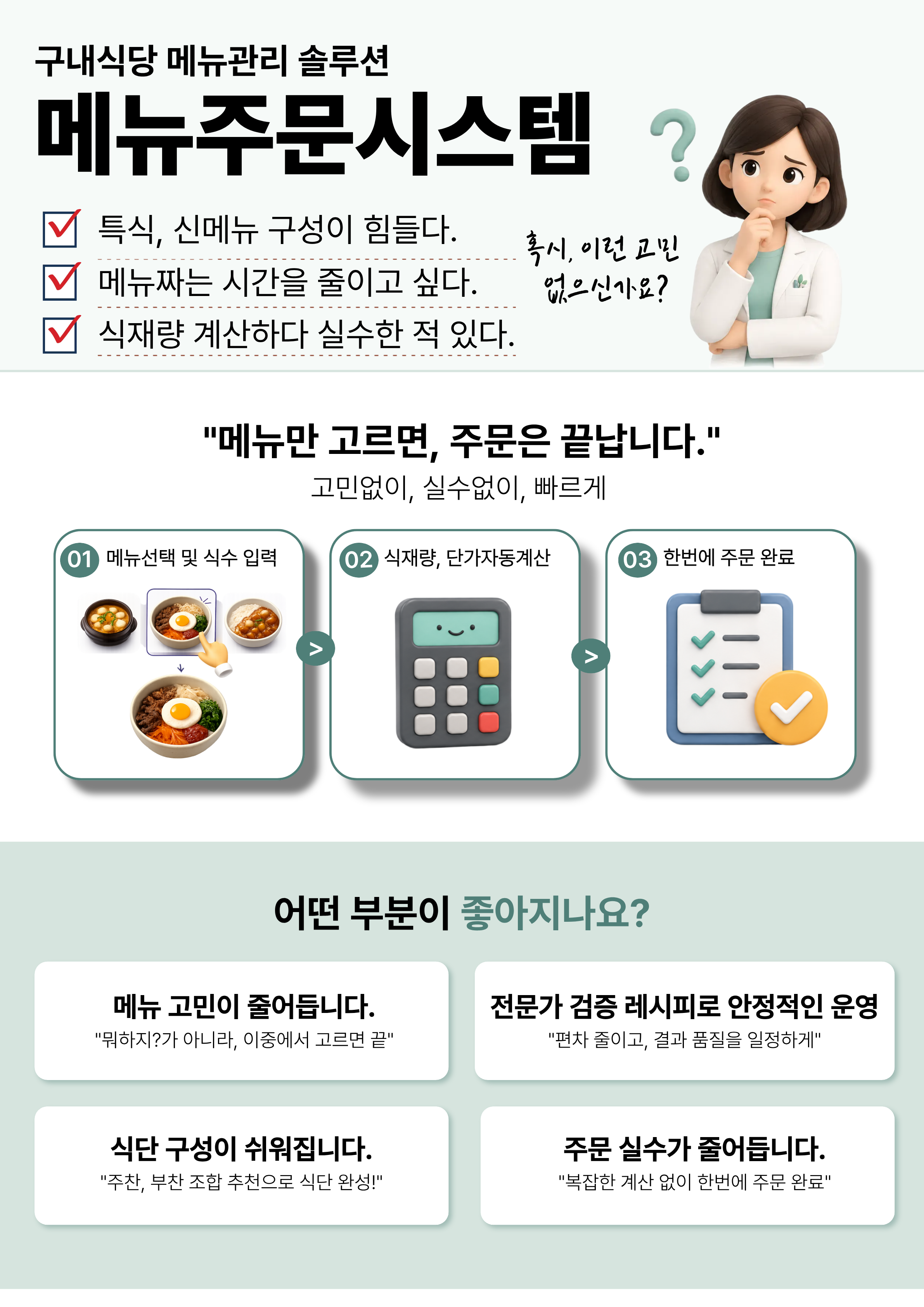
CJ프레시웨이의 메뉴주문시스템은 단체급식 사업장에서 메뉴 선택부터 식재 구성, 1인량 기준 주문량 계산, 식자재 발주까지 한 번에 연결할 수 있도록 지원하는 메뉴 기반 주문 솔루션이다.
기존 식자재 발주가 개별 상품 단위로 이뤄졌다면, 메뉴주문시스템은 실제 급식 운영에 필요한 메뉴를 중심으로 식자재를 구성하고 주문할 수 있다는 점이 특징이다. 영양사가 시스템에 등록된 메뉴를 선택하고 식수 인원을 입력하면 해당 메뉴에 필요한 식재료와 기준 사용량을 확인할 수 있고, 발주까지 연계할 수 있다.
즉, 단순히 식자재를 주문하는 시스템이 아니라 메뉴 기획, 식재 산출, 발주, 운영 콘텐츠 활용까지 연결하는 급식 운영 표준화 솔루션이라고 볼 수 있다.
Q. 메뉴주문시스템을 개발하게 된 배경은 무엇인가?
단체급식 현장에서는 식단을 구성하고 식재료를 발주하는 과정에서 여러 어려움이 반복적으로 발생한다. 매일 새로운 메뉴를 고민해야 하고, 담당자별 경험에 따라 메뉴 구성이나 조리 품질에 편차가 생기기도 한다. 식수 인원에 맞는 발주량을 산정하는 일도 쉽지 않아 과소 발주나 과다 발주에 대한 부담이 있다.
특히 영양사는 메뉴 기획, 식재료 산출, 원가 관리, 조리 공정 확인, 고객사 요구 반영 등 다양한 업무를 동시에 수행한다. 운영 인력이 충분하지 않은 현장에서는 이러한 업무가 더 큰 부담으로 작용할 수 있다.
CJ프레시웨이는 이러한 현장의 불편을 줄이기 위해 상품을 단순히 판매하는 방식에서 나아가, 실제 급식 운영에 바로 적용할 수 있는 메뉴 단위 솔루션을 개발했다. 메뉴주문시스템은 급식 운영이 개인의 경험에만 의존하지 않도록 메뉴와 레시피, 식재 구성, 발주 기준을 표준화해 지원하는 데 초점을 맞추고 있다.
Q. 단체급식 현장에서 영양사들이 겪는 가장 큰 어려움은 무엇인가?
단체급식은 매일 일정한 품질의 식사를 안정적으로 제공해야 하는 동시에, 이용자 만족도를 높이기 위한 메뉴 다양성도 확보해야 한다. 영양사 입장에서는 제한된 시간 안에 영양 균형, 원가, 조리 효율, 식재료 수급, 고객사 요구사항을 모두 고려해야 한다.
현장에서 자주 제기되는 어려움은 크게 메뉴 구성 부담, 조리 품질 편차, 발주량 산정의 번거로움, 운영 인력 부족 등이다. 특히 신규 메뉴나 특식을 운영할 때는 레시피 검토, 식재료 구성, 조리 방법 확인, 홍보물 준비까지 별도 업무가 발생한다.
메뉴주문시스템은 이 같은 반복 업무를 줄이는 역할을 한다. 검증된 메뉴와 레시피를 기반으로 식단을 구성하고, 식수에 맞는 식재량을 산출할 수 있어 영양사는 단순 계산이나 발주 업무에 쓰는 시간을 줄일 수 있다. 그만큼 이용자 만족도 개선, 고객사 커뮤니케이션, 식당 서비스 품질 강화 등 보다 중요한 업무에 집중할 수 있다.
Q. 메뉴주문시스템 개발 과정에서 기억에 남는 애로사항이 있다면?
가장 어려웠던 부분은 ‘표준화’와 ‘현장의 다양성’ 사이에서 균형점을 찾는 것이었다. 메뉴주문시스템을 만들기 위해서는 메뉴별 식재 구성과 1인량, 레시피 등을 일정한 기준으로 표준화해야 한다. 하지만 실제 현장에 가보면 같은 메뉴라도 사업장 규모나 이용객 특성, 조리 인력, 설비, 기존 운영 방식에 따라 사용하는 상품과 양이 달라질 수 있다.
결국 하나의 정답을 만드는 것보다 ‘활용할 수 있는 표준을 제공하되 현장이 수정할 수 있게 하자’는 방향으로 발전했다. ‘나만의 메뉴’ 같은 기능도 이러한 고민에서 나온 결과다.
또 하나는 기능을 많이 제공하는 것과 사용하기 쉬운 시스템을 만드는 것 사이의 균형이었다. 현장의 요구를 모두 넣으면 오히려 시스템이 복잡해질 수 있기 때문에, VOC를 수집한 뒤 실제 사용 빈도와 효과를 기준으로 우선순위를 정해 지속적으로 개선하고 있다.
Q. 메뉴주문시스템이 제공하는 핵심 가치는 무엇인가?
핵심 가치는 운영 효율화, 품질 향상, 운영 표준화다. 먼저 메뉴 검토와 발주에 소요되는 시간을 줄여 반복 업무를 축소할 수 있다. 메뉴를 선택하면 필요한 식재 구성과 1인량 기준 주문량을 확인할 수 있어 발주 업무가 간소화된다.
둘째, 검증된 메뉴와 레시피를 활용함으로써 조리 품질 편차를 줄일 수 있다. 담당자가 바뀌더라도 동일한 기준을 참고할 수 있기 때문에 사업장별 운영 수준을 일정하게 유지하는 데 도움이 된다.
셋째, 식재료 비용 편차와 발주 오류를 줄이는 데 기여할 수 있다. 식수 인원에 맞춰 적정량을 산출해 발주할 수 있어 식재료 폐기율 감소와 원가 관리 효과도 기대할 수 있다.
Q. 메뉴주문시스템의 주요 기능은 무엇인가?
대표적인 기능은 ‘나만의 메뉴’다. 표준 메뉴를 기반으로 고객사별 운영 환경에 맞게 구성 상품과 1인량 등을 수정해 저장하고, 이후 반복적으로 활용할 수 있는 기능이다. 사업장별 식수 규모나 조리 환경, 고객 선호가 다른 만큼 현장 맞춤형 메뉴 관리가 가능하다는 것이 장점이다.
자주 사용하는 메뉴는 즐겨찾기로 등록해 반복적인 메뉴 탐색 시간을 줄일 수 있다. 메뉴별 특이사항이나 운영 정보를 메모로 기록할 수 있어, 현장에서 축적한 운영 노하우를 메뉴 관리에 반영할 수도 있다.
또한 메뉴 이미지 확대 보기와 조리 꿀팁 기능을 통해 메뉴 완성 이미지, 조리 포인트, 유의사항, 활용 팁 등을 확인할 수 있다. 영양사뿐만 아니라 조리 현장에서도 메뉴 이해도를 높이고, 보다 안정적인 품질로 메뉴를 구현하는 데 도움이 된다.
Q. 식단 구성과 메뉴 콘텐츠 측면에서는 어떤 지원을 하나?
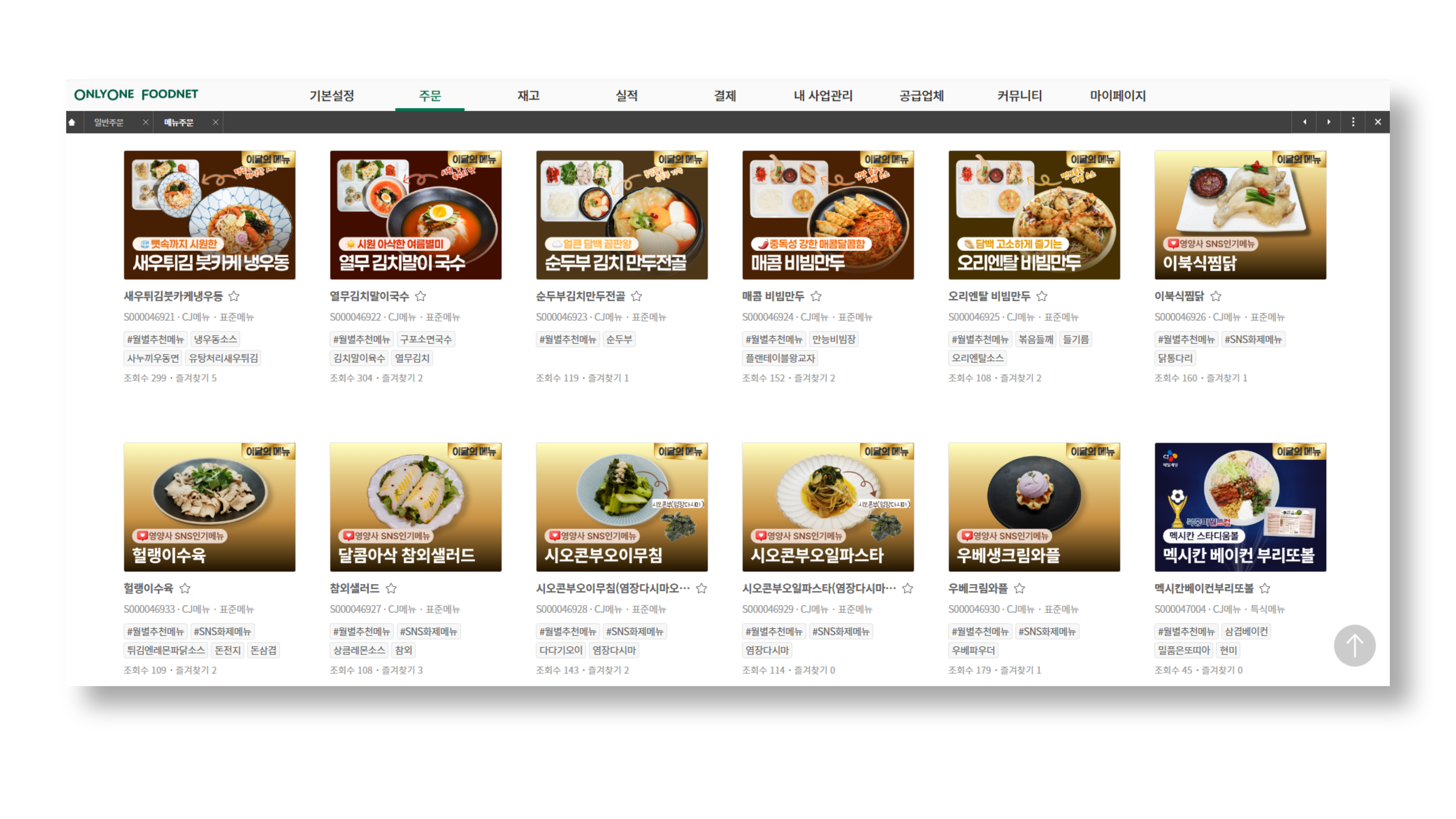
CJ프레시웨이는 월별 추천 식단과 전략메뉴를 통해 고객이 식단 구성 아이디어를 얻을 수 있도록 지원하고 있다. 추천 식단은 CJ프레시웨이가 제안하는 월별 식단 콘텐츠로, 월별 전략메뉴를 반영해 고객이 식단 편성에 참고할 수 있도록 구성된다. 일부 메뉴는 메뉴주문과 연동돼 식단 확인 후 해당 메뉴를 바로 주문할 수 있다.
메뉴주문 메인에는 제철 식재료, 시즌 이벤트, 상품 프로모션 등을 반영한 월별 전략메뉴가 노출된다. 매월 16~18종의 ‘이달의 메뉴’를 정기적으로 업데이트하고 있으며, 식판 이미지, 조리 영상, 이벤트 POP 등 현장에서 바로 활용할 수 있는 콘텐츠도 함께 제공한다.
메뉴 검색 기능도 강화하고 있다. 추천 키워드를 통해 CJ프레시웨이가 제안하는 테마형 메뉴를 확인할 수 있고, 메뉴 카테고리나 주재료 기준으로 원하는 메뉴를 탐색할 수 있다. 급식 TOP100 메뉴, 셰프 특선 메뉴, 트렌드 메뉴, 제철 재료 메뉴, 중식 전문 메뉴 등 다양한 카테고리를 통해 메뉴 선택 폭을 넓히고 있다.
Q. 메뉴주문시스템을 활용하면 고객은 어떤 효과를 기대할 수 있나?
가장 큰 효과는 식단 구성과 발주 업무의 효율화다. 메뉴를 선택하면 해당 메뉴에 필요한 식재료와 기준량을 확인할 수 있고, 식수 인원에 맞춰 발주량을 산출할 수 있어 업무 시간을 줄일 수 있다.
또한 적정량 발주를 통해 식재료 폐기율 감소 효과도 기대할 수 있다. 단체급식은 식수 예측과 발주량 관리가 운영 효율에 큰 영향을 미치는데, 메뉴주문시스템은 메뉴별 기준량과 식수 인원을 연계해 보다 정교한 발주를 지원한다.
현장에서는 메뉴 고민 시간이 줄고, 완제품 소스나 표준 레시피를 활용해 조리 시간을 단축할 수 있다는 점도 장점이다. 특식 운영 시에도 추천 메뉴 구성과 POP, 홍보 콘텐츠를 함께 활용할 수 있어 메뉴 운영과 현장 커뮤니케이션 부담을 낮출 수 있다.
Q. 메뉴 데이터와 레시피 콘텐츠는 어느 정도 확보돼 있나?
CJ프레시웨이는 현재 약 5,600개의 메뉴 데이터를 확보하고 있으며, 이를 기반으로 단체급식 사업장의 식단 구성과 식자재 발주 업무를 지원하고 있다.
고객용 메뉴 콘텐츠 측면에서는 7,000개 이상의 표준 레시피와 100개 이상의 스테디 메뉴를 제공하고 있다. 여기에 매월 16~18종의 이달의 메뉴, 조리 영상, 이벤트 POP 등 현장 활용형 콘텐츠를 더해 영양사와 조리 담당자가 보다 쉽게 메뉴를 선택하고 운영할 수 있도록 돕고 있다.
이러한 메뉴 데이터와 콘텐츠는 단체급식 이용자에게 더 다양한 메뉴 경험을 제공하고, 고객 만족도를 높이는 기반이 되고 있다.
Q. 케어급식 분야에서도 활용할 수 있나?
메뉴주문시스템은 일반 단체급식뿐만 아니라 병원, 복지시설 등 케어급식 영역에서도 활용 가능성이 크다. 케어급식은 대상자의 건강 상태와 식사 목적에 따라 메뉴 구성과 영양 설계가 더욱 중요하기 때문에, 영양사의 업무 부담이 큰 분야다.
CJ프레시웨이는 복지시설 맞춤형 케어식 레시피도 지속 확대하고 있다. 예를 들어 연세암병원과 공동 개발한 맞춤 케어 메뉴 79종을 운영하고 있으며, 항암 치료와 회복기 동안의 영양 공급, 식사 관리, 맛과 영양을 고려한 요리 개발, 증상과 컨디션에 맞춘 메뉴 제공 등을 방향으로 삼고 있다.
식사부터 간식까지 다양한 케어식 메뉴를 제안함으로써 병원과 복지시설 영양사의 식단 구성 부담을 줄이고, 이용자 특성에 맞는 급식 운영을 지원할 수 있다.
Q. CJ프레시웨이 입장에서 메뉴주문시스템은 어떤 의미가 있나?
메뉴주문시스템은 CJ프레시웨이가 단순 식자재 공급을 넘어, 고객의 급식 운영 전반을 지원하는 솔루션형 사업자로 진화하고 있다는 점을 보여주는 사례다.
단체급식 경로에서 식자재 유통 경쟁력은 단순히 상품을 얼마나 안정적으로 공급하느냐에 그치지 않는다. 고객이 실제 현장에서 메뉴를 어떻게 구성하고, 어떤 방식으로 조리하며, 식수 인원에 맞춰 얼마나 효율적으로 발주할 수 있는지가 중요해지고 있다.
CJ프레시웨이는 메뉴주문시스템을 통해 상품과 메뉴, 식단과 발주를 하나의 체계로 연결하고 있다. 이를 기반으로 고객사의 운영 편의성을 높이고, 단체급식 경로의 수주 경쟁력을 강화하는 동시에 추가적인 식자재 발주 물량 확보도 기대할 수 있다.
Q. 최근에는 메뉴주문시스템 관련 마케팅도 강화하고 있다고 들었다. 어떤 방향인가?
CJ프레시웨이는 메뉴주문 마케팅을 단순 이벤트 중심이 아니라 매출, 고객 행동, VOC를 기반으로 한 상시 운영 체계로 전환하고 있다.
하반기에는 프로모션을 단순 경품성 이벤트가 아닌 매출 확대, 고객 행동 활성화, 고객 Voice 확보라는 세 가지 목적을 중심으로 재설계했다. 서비스 경험 확대에서 실제 주문으로 이어지고, 이후 고객 의견을 확보해 다시 서비스 개선에 반영하는 선순환 구조를 만드는 것이 목표다.
Q. 향후 메뉴주문시스템은 어떤 방향으로 발전할 예정인가?
CJ프레시웨이는 메뉴주문시스템을 통해 ‘식자재 단위 발주’에서 ‘메뉴 단위 발주’로, 나아가 ‘식단 단위 발주’까지 서비스를 확대하며 단체급식 경로의 식자재 유통 방식을 고도화하고자 한다. 식단 단위 발주 단계까지 접어들면 데이터 기반의 일별 및 월별 식단 편성을 통해 이용객들에게 보다 균형 잡힌 식사를 제공할 수 있으며, 영양사의 부담까지 획기적으로 낮추는 시스템 혁신이 이뤄질 것으로 전망한다.
앞으로도 고객사의 운영 데이터를 반영해 메뉴 추천과 식단 편성 기능을 강화하고, 현장 의견을 바탕으로 사용 편의성을 지속 개선할 계획이다. 특히 실제 영양사와 조리 현장의 VOC를 반영해 메뉴 콘텐츠, 조리 정보, 발주 편의 기능을 고도화함으로써 고객이 체감할 수 있는 운영 효율을 높이는 데 집중할 예정이다.
궁극적으로 메뉴주문시스템은 영양사의 업무 부담을 줄이고, 단체급식 사업장의 운영 품질을 높이며, 이용자에게 더 만족도 높은 식사 경험을 제공하는 기반이 될 것으로 기대된다. CJ프레시웨이는 이를 통해 단체급식 경로의 식자재 유통 경쟁력을 지속 강화해 나갈 계획이다.
Choose a Menu and Order the Ingredients
—A New Way of Ordering for Institutional Foodservice
CJ Freshway streamlines menu planning and ingredient ordering for institutional foodservice with its Menu Ordering System
Customized ingredient calculations based on the number of diners improve ordering accuracy and help reduce food waste
Menu data-driven solution supports standardized foodservice operations
At institutional foodservice sites, dietitians perform a wide range of tasks each day, from menu planning and ingredient calculations to ordering, cost management, and reviewing cooking procedures. They must ensure nutritional balance and menu variety while maintaining stable operations within limited budgets and staffing constraints. In particular, manually calculating the ingredients and order quantities required for the expected number of diners demands considerable time and experience.
Expectations among diners are also rising. As demand grows for new menu options that reflect dining trends and seasonal ingredients, dietitians face an increasing burden in menu planning. At the same time, many sites continue to experience staffing shortages and heavy workloads, making systematic support for streamlining menu planning and ordering more important than ever.
To address these challenges, CJ Freshway operates its Menu Ordering System, which connects menu selection with ingredient ordering. Whereas users previously had to search for and order individual products, the system allows them to select a menu and proceed seamlessly from identifying the required ingredients to placing an order.
More than a simple ordering tool, the Menu Ordering System is a comprehensive solution that supports foodservice operations ranging from menu planning and cooking to ingredient ordering. By systematizing accumulated menu data and operational expertise, the system is designed to reduce repetitive tasks for dietitians and help maintain consistent operating standards across foodservice sites.
The Menu Ordering System is changing the basis of institutional foodservice procurement from selecting individual ingredients to ordering by menu. We spoke with Shin Seung-yoon, Head of CJ Freshway’s Foodservice Innovation & Growth Division, who oversees system planning and development for the growth of the company’s food distribution business, about why the system was developed, the changes it is expected to bring to foodservice sites, and how it will evolve going forward.
Q. What is CJ Freshway’s Menu Ordering System?
CJ Freshway’s Menu Ordering System is a menu-based ordering solution that enables institutional foodservice operators to manage the entire process—from menu selection and ingredient configuration to calculating order quantities based on per-serving standards and placing ingredient orders—within a single system.
Traditional ingredient ordering is conducted on an individual product basis. In contrast, the Menu Ordering System allows users to configure and order ingredients around the actual dishes they plan to serve. Once a dietitian selects a menu registered in the system and enters the expected number of diners, they can check the required ingredients and standard quantities and proceed directly to ordering.
In other words, it is not merely an ingredient ordering system. It is a standardized foodservice operations solution that integrates menu planning, ingredient calculations, ordering, and the use of operational content.
Q. What led CJ Freshway to develop the Menu Ordering System?
Institutional foodservice sites repeatedly encounter several challenges when planning menus and ordering ingredients. Dietitians must develop new menus every day, and differences in individual experience can lead to variations in menu composition and cooking quality. Calculating appropriate order quantities for the expected number of diners can also be difficult, creating concerns about underordering or overordering.
Dietitians are responsible for multiple tasks at once, including menu planning, ingredient calculations, cost management, reviewing cooking procedures, and responding to client requirements. At sites with limited staffing, these responsibilities can become an even greater burden.
To address these operational challenges, CJ Freshway moved beyond simply supplying products and developed a menu-based solution that could be applied directly to foodservice operations. The Menu Ordering System focuses on standardizing menus, recipes, ingredient configurations, and ordering criteria so that operations do not depend solely on an individual employee’s experience.
Q. What are the greatest challenges dietitians face at institutional foodservice sites?
Institutional foodservice operators must provide meals of consistent quality every day while ensuring sufficient menu variety to improve diner satisfaction. Dietitians must consider nutritional balance, cost, cooking efficiency, ingredient availability, and client requirements—all within a limited amount of time.
The most frequently cited challenges include the burden of menu planning, variations in cooking quality, the inconvenience of calculating order quantities, and staffing shortages. When introducing a new menu or special meal in particular, additional work is required, including reviewing recipes, configuring ingredients, checking cooking methods, and preparing promotional materials.
The Menu Ordering System helps reduce these repetitive tasks. Dietitians can plan meals using verified menus and recipes and calculate the appropriate ingredient quantities according to the expected number of diners. By spending less time on manual calculations and ordering, they can focus on higher-value responsibilities such as improving diner satisfaction, communicating with clients, and enhancing the overall quality of foodservice.
Q. What was the most challenging part of developing the Menu Ordering System?
The greatest challenge was finding the right balance between standardization and the diverse conditions found at individual foodservice sites. Developing the Menu Ordering System required us to standardize each menu’s ingredient composition, per-serving quantities, and recipe. In practice, however, even the same dish may require different products and quantities depending on the size of the site, diner characteristics, available cooking staff and equipment, and existing operating methods.
Rather than trying to create a single correct answer, we decided to provide practical standards while allowing individual sites to modify them. The “My Menu” feature was developed as a result of this approach.
Another challenge was balancing extensive functionality with ease of use. Incorporating every request from the field could make the system overly complex. We therefore collect Voice of Customer, or VOC, feedback and prioritize improvements based on actual frequency of use and expected effectiveness.
Q. What are the core benefits of the Menu Ordering System?
The system’s three core benefits are operational efficiency, quality improvement, and operational standardization.
First, it reduces the time required to review menus and place orders, thereby minimizing repetitive work. Once a menu is selected, users can review the necessary ingredients and order quantities based on per-serving standards, simplifying the ordering process.
Second, verified menus and recipes help reduce variations in cooking quality. Even when the person responsible for operations changes, the same standards remain available for reference, helping maintain consistent operating quality across different sites.
Third, the system can help reduce variations in ingredient costs and minimize ordering errors. By calculating appropriate quantities based on the expected number of diners, it can also contribute to lower food waste and more effective cost management.
Q. What are the system’s main features?
One of its key features is “My Menu.” Users can modify the ingredients and per-serving quantities of a standard menu to suit a client’s specific operating environment, save the customized version, and reuse it later. As each site differs in terms of the number of diners, cooking conditions, and customer preferences, the feature enables customized menu management.
Frequently used menus can also be added to Favorites, reducing the time spent repeatedly searching for them. Users can record menu-specific notes and operational information, allowing the expertise accumulated at individual foodservice sites to be incorporated into menu management.
The system also provides enlarged menu images and cooking tips, allowing users to view finished-dish images, key cooking points, precautions, and practical preparation advice. These features improve menu understanding among both dietitians and kitchen staff and help them execute dishes with more consistent quality.
Q. How does the system support menu planning and menu content?
CJ Freshway provides monthly recommended meal plans and strategic menu suggestions to help customers develop new ideas for their menus. The recommended meal plans are monthly menu-planning resources proposed by CJ Freshway and incorporate the company’s strategic menu selections for each month. Some items are connected directly to the Menu Ordering System, enabling customers to review a meal plan and immediately order the corresponding menu.
The system’s main page features monthly strategic menus reflecting seasonal ingredients, seasonal events, and product promotions. CJ Freshway regularly adds 16 to 18 “Menus of the Month,” together with ready-to-use content such as meal-tray images, cooking videos, and event point-of-purchase materials.
Menu search capabilities are also being enhanced. Recommended keywords allow users to explore themed menus proposed by CJ Freshway, while search filters help them find dishes by menu category or primary ingredient. Categories such as the Top 100 Foodservice Menus, Chef’s Special Menus, Trending Menus, Seasonal Ingredient Menus, and Chinese Cuisine Menus further broaden the range of available choices.
Q. What benefits can customers expect from using the Menu Ordering System?
The greatest benefit is improved efficiency in menu planning and ingredient ordering. After selecting a menu, users can review the required ingredients and standard quantities and calculate order quantities based on the expected number of diners, reducing the time required for these tasks.
More accurate ordering can also help reduce food waste. In institutional foodservice, diner forecasts and order-quantity management significantly affect operational efficiency. The Menu Ordering System supports more precise ordering by linking menu-specific standard quantities with the expected number of diners.
The system also reduces the time spent deciding what to serve. Ready-made sauces and standardized recipes can shorten preparation time, while recommended menu combinations, promotional materials, and other content can ease the operational and communication burden associated with special meals.
Q. How much menu data and recipe content has CJ Freshway secured?
CJ Freshway currently has data on approximately 5,600 menus, which it uses to support menu planning and ingredient ordering at institutional foodservice sites.
In terms of customer-facing menu content, the company provides more than 7,000 standardized recipes and over 100 proven, consistently popular menus. These are supplemented by 16 to 18 Menus of the Month, cooking videos, event promotional materials, and other practical content designed to make it easier for dietitians and kitchen staff to select and serve menus.
This extensive menu data and content serves as a foundation for providing diners with greater menu variety and improving customer satisfaction.
Q. Can the Menu Ordering System also be used in healthcare and senior care foodservice?
The system has significant potential not only in general institutional foodservice but also in healthcare and senior care settings, including hospitals and welfare facilities. In these settings, menu composition and nutritional planning are particularly important because they must reflect each diner’s health condition and dietary needs. This places an even greater workload on dietitians.
CJ Freshway continues to expand its range of care-food recipes tailored to welfare facilities. For example, the company currently offers 79 customized care menus jointly developed with Yonsei Cancer Center. These menus are designed to support nutritional intake and dietary management during cancer treatment and recovery, deliver both flavor and nutrition, and accommodate different symptoms and physical conditions.
By proposing a diverse range of care-food options, from meals to snacks, the system can reduce the menu-planning burden on dietitians at hospitals and welfare facilities while supporting foodservice operations tailored to the needs of individual diners.
Q. What does the Menu Ordering System mean for CJ Freshway?
The Menu Ordering System demonstrates CJ Freshway’s evolution from a food ingredient supplier into a solution provider that supports customers across the full spectrum of foodservice operations.
Competitiveness in ingredient distribution for institutional foodservice is no longer determined solely by how reliably a company can supply products. It is becoming increasingly important to understand how customers plan their menus, prepare dishes, and order the right quantities for the number of diners they serve.
Through the Menu Ordering System, CJ Freshway connects products, menus, meal plans, and ordering within a single framework. This enhances convenience for customers, strengthens the company’s competitiveness in securing institutional foodservice accounts, and is also expected to generate additional ingredient orders.
Q. CJ Freshway has recently strengthened marketing for the Menu Ordering System. What direction is the company taking?
CJ Freshway is shifting its Menu Ordering System marketing from one-off events to an ongoing operational model based on sales data, customer behavior, and VOC feedback.
In the second half of the year, the company redesigned its promotions around three objectives: increasing sales, encouraging customer engagement, and gathering customer feedback, rather than simply offering prizes. The goal is to create a virtuous cycle in which more customers experience the service, that experience leads to actual orders, and subsequent feedback is used to improve the service again.
Q. How will the Menu Ordering System evolve going forward?
Through the Menu Ordering System, CJ Freshway aims to advance ingredient distribution for institutional foodservice from ingredient-level ordering to menu-level ordering and, ultimately, full meal plan-level ordering. Once meal plan-level ordering becomes possible, data-driven daily and monthly meal planning will help provide diners with more nutritionally balanced meals while significantly reducing the workload of dietitians.
CJ Freshway will continue strengthening menu recommendations and meal-planning capabilities by incorporating customer operational data. It also plans to improve usability based on feedback from foodservice sites. In particular, the company will integrate VOC feedback from dietitians and kitchen staff to enhance menu content, cooking information, and ordering features, focusing on operational improvements that customers can clearly experience.
Ultimately, the Menu Ordering System is expected to reduce the workload of dietitians, enhance the operating quality of institutional foodservice sites, and provide diners with more satisfying meal experiences. Through these efforts, CJ Freshway will continue to strengthen its competitiveness in ingredient distribution for the institutional foodservice market.
 타깃플랫폼
 고객센터